Easy Fox AI Driving Simulator Cost: Over $1,000 a Day
Why Easy Fox reports over $1,000 a day in AI costs for its driving demo, what players will pay, and how live AI games can control API spending.
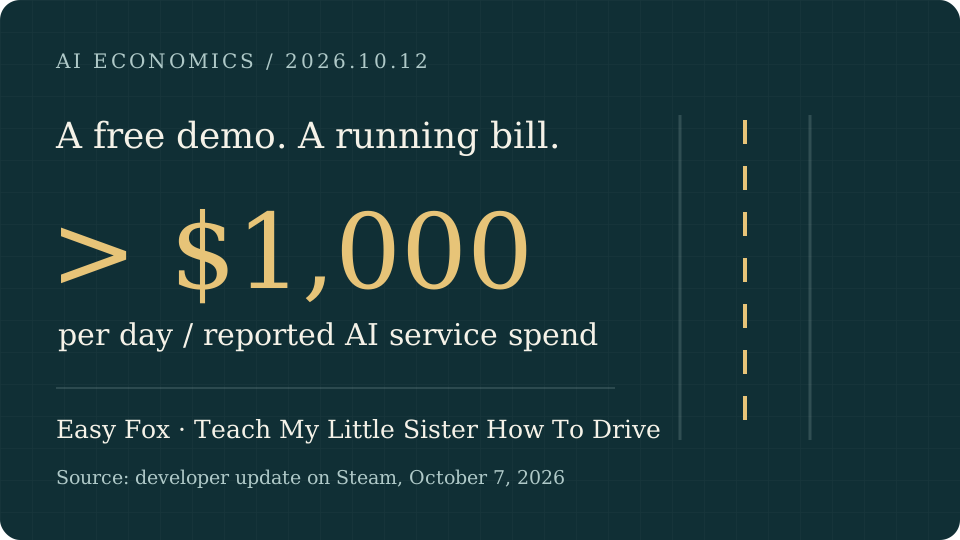
Easy Fox says its AI driving simulator demo costs more than $1,000 per day in AI services. That is the developer's operating bill for Teach My Little Sister How To Drive, not the price of a copy of the game or a racing simulator rig. In its October 7 Steam update, the four-person team says demo players grew more than twentyfold in a month and it took out a bank loan to keep the demo running.
Sources checked October 12, 2026. Costs are developer-reported; no itemized invoice has been published in the sources below.
The cost at a glance
| Question | What the sources establish |
|---|---|
| What is the daily AI bill? | More than $1,000 per day for the demo, according to Easy Fox. |
| How much did the audience grow? | More than 20 times in the preceding month; this is player growth, not a measured 20-times increase in spending. |
| Who pays? | The developer operates the demo's AI services. This figure is not a player subscription price. |
| Will buyers pay per token? | The team plans to include expected AI usage in the paid game's price, with no separate charge for individual token usage. |
| What is the final purchase price? | No price was shown in the Steam store data checked for this article. Release was listed for January 2027. |
| Is the demo shutting down? | The October 7 update says early closure is possible, but no decision had been made in that update. Check Steam for later changes. |
Per day or per month? A source discrepancy
PC Gamer's October 11 report has “$1,000 per month” in its headline and URL. Its body quotes Easy Fox saying “over $1,000 per day.” The Steam announcement and AUTOMATON's October 9 report both use per day. We follow the primary announcement. The headline's monthly figure should not be used to calculate this game's running costs.
Why a free demo can generate a recurring AI bill
The player sits in the passenger seat and gives spoken driving instructions. An AI character interprets those instructions and responds during play. Unlike dialogue recorded once and shipped with a game, live model requests consume service capacity as people play.
The developer's global AI transparency page describes voice streaming directly from the game to external providers, along with relevant game state and recent conversation turns. Easy Fox's server verifies ownership and issues a temporary token; it does not relay the voice stream. That architecture still produces provider usage billed to the operator.
The transparency page lists gemini-2.5-flash on Vertex AI as the normal primary service, followed by services it labels ChatGPT Realtime Mini 2.1 and ChatGPT Realtime Mini as fallbacks. These are the developer's labels, not independently verified API model identifiers or pricing tiers. The October 7 update says Gemini usage-limit errors had led to heavier reliance on OpenAI. The global configuration also differs from the mainland China version.
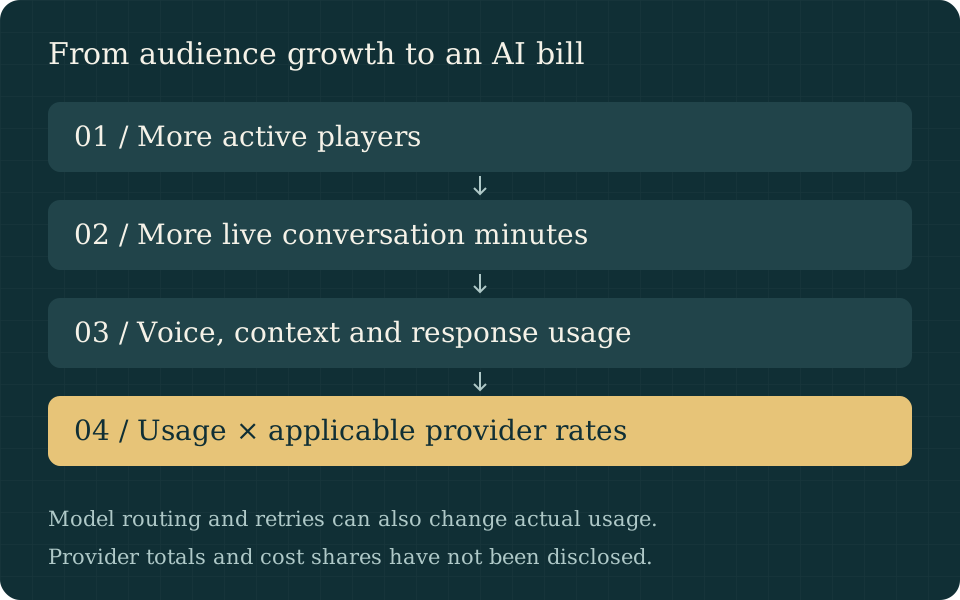
| Cost driver | Why it matters | What is still unknown |
|---|---|---|
| Active conversation time | Longer sessions can keep consuming service capacity. | Total daily player-hours and billable audio minutes. |
| Input and output | Voice, context and generated replies contribute to usage according to the service's billing rules. | Token counts, modality mix and any negotiated rates. |
| Model routing | Failures can shift traffic to a different provider with different rates and behavior. | The share of requests and cost handled by each model. |
| Local computation | Moving suitable work onto a player's device could reduce some hosted calls. | Supported local models and real savings at an acceptable quality level. |
There is not enough public information to draw an honest pie chart of Gemini versus OpenAI spending, calculate a reliable cost per player, or attribute a fixed share to speech generation. Peak concurrent players are not daily users or player-hours, so dividing the daily bill by a concurrency peak would be misleading.
Why the costs rose so quickly
AUTOMATON links the new attention to gaming streamers, especially in Japan, and the game's unpredictable spoken exchanges. The primary update confirms audience growth of more than twentyfold. A free demo can therefore acquire recurring usage much faster than it acquires revenue.
Capacity pressure arrived alongside the financial pressure. Easy Fox reports Gemini usage-limit errors and a fallback model producing overly long replies, unnatural dialogue and incorrect commands. Those observations explain the operational difficulty; they do not establish how much extra money the fallback costs. The team says it is trying to restore reliable Gemini access and investigating local models for players with capable GPUs.
What $1,000 a day means over time
The chart uses exactly $1,000 per day as an illustrative baseline, below the developer's reported “over $1,000” figure. It assumes constant daily use. These are arithmetic scenarios, not disclosed weekly or monthly bills, and not a forecast.
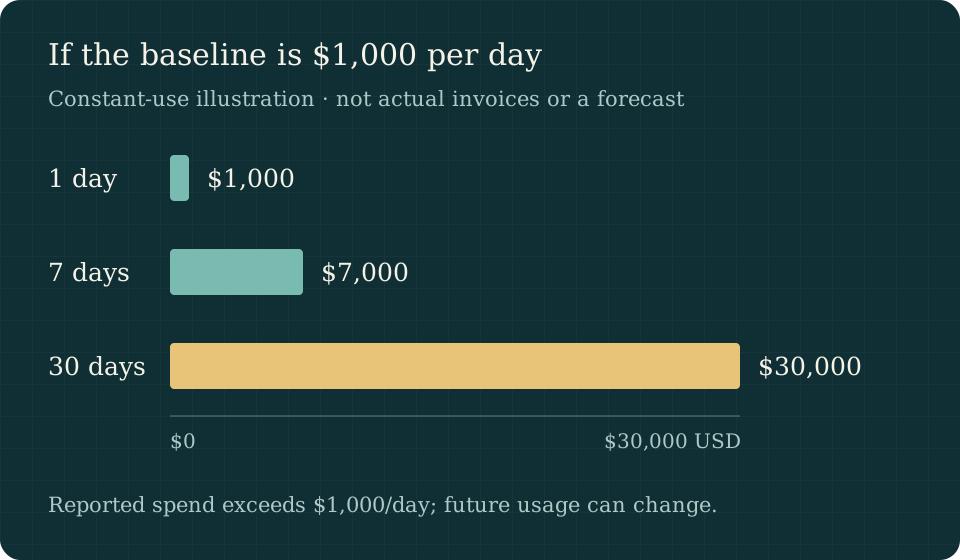
| Duration | Calculation | Illustrative AI service spend |
|---|---|---|
| 1 day | $1,000 × 1 | $1,000 |
| 7 days | $1,000 × 7 | $7,000 |
| 30 days | $1,000 × 30 | $30,000 |
The table excludes salaries, other hosting costs, taxes and loan interest. Real spend changes with active playtime, model selection, pricing, failures and any demo limits. A useful planning model is daily conversation minutes multiplied by measured cost per minute, split by provider and billing modality where necessary.
How live AI games can lower operating costs
These are engineering options, not claims about features Easy Fox has already shipped or guaranteed savings.
- Measure cost per useful minute of play. Track billable usage, provider, latency, failure rate and session duration together. Compare completed interactions rather than only token prices.
- Bound demo consumption. Session limits, daily allowances, queues and a hard spending ceiling make a free trial's maximum exposure clearer. Explain limits before a player starts.
- Keep replies and context focused. Limit unnecessary output and repeated history; use voice activity detection where appropriate. Test that interruptions and shorter context do not break character behavior.
- Route simple actions deterministically. Repeated tutorial instructions or basic commands may use conventional game logic and prewritten dialogue. Reserve generative calls for interactions that benefit from them.
- Evaluate fallbacks on quality and cost. A cheaper response is not useful if players have to repeat instructions. Limit retries and compare providers on the same realistic conversations.
- Benchmark local inference. Local models can trade cloud spending for device requirements, power use and support work. Easy Fox is exploring this, but a universal GPU-memory threshold is not established by the primary update.
For more context, read our OpenAI platform workflow guide, DeepSeek chat and API guide, and multi-model platform guide. They cover evaluation, integration and routing decisions that matter when turning an AI demo into an operated service.
Frequently asked questions
Is Easy Fox charging players $1,000?
No. The reported figure is the developer's daily demo AI service spend. It is not a per-player fee, a monthly subscription or the cost of a steering wheel setup.
Will the full game need a separate AI subscription?
The October 7 announcement says expected AI usage will be accounted for in the purchase price and players will not be charged separately for individual token usage. This is a stated plan; consult the final Steam listing and terms when the game launches.
Does a free demo mean the AI is free to run?
No. A demo can be free for players while its operator pays metered inference costs. More playtime can increase those costs without producing corresponding sales.
Can it run entirely offline?
The documented global setup uses external services. The team is investigating local models as a supplementary option, which is not a promise of a fully offline release.
Sources and verification notes
- Easy Fox: v1.2.9 update and development status, October 7, 2026 — primary source for daily spend, player growth, team size, loan and planned purchase model.
- Easy Fox: how this game uses AI, updated August 27, 2026 — global routing and data flow; read with the later update because current routing can differ.
- AUTOMATON, October 9, 2026 — reporting on streamer attention and demo economics.
- PC Gamer, October 11, 2026 — additional reporting; its headline and body disagree on the daily/monthly unit as explained above.
- Official Steam store — current game description, availability and release information.
This article explains publicly reported operating costs. It does not reproduce an invoice, independently audit the studio's finances, or predict the game's profitability.